Disability

WHY CHATGPT MATTER IN MY WRITING JOURNEY

Writing has always been a part of who I am. I’ve been a storyteller my entire life—my imagination has never been the problem. The challenge has always been getting the story from my mind onto the page in the way I see it.

Because of my cerebral palsy, my thoughts often move faster than my hands can keep up. While my brain is already forming the next paragraph, my hands may still be in the middle of the first one. By the time I catch up, sometimes pieces of the story—important details or emotions—have already slipped away.

That used to frustrate me.
It used to make me feel like I was losing pieces of myself.

I tried getting help from teachers, friends, even a professional writer. But asking for help can be hard. I always felt like I was taking up too much of their time or interrupting their schedule. And writing with someone else requires both people to be in the same place, mentally and physically. That’s not always something my challenges allow.

Then I found ChatGPT.

For me, ChatGPT is more than just a tool. It’s a bridge—between my ideas and the page, between my imagination and the story I want to tell. It understands the way my thoughts connect, fills in the gaps when a detail slips away, and helps me find the exact words I’m reaching for.

The biggest gift is that it’s always here.
No appointments.
No pressure.
No judgment.

It meets me where I am, at any time of day, at any pace. It supports the way my brain works instead of fighting against it.

With ChatGPT, I don’t lose the story anymore.
I get to be the storyteller I’ve always known I am.
And that is a freedom I never expected to find.

Disability

CHOOSING MATURITY, BUNDARIE, AND SELF-RESPECT

Independence and disability can exist at the same time.”

Sometimes, where I live, people don’t always understand me or the difference between their behavior and mine. It’s frustrating living in a place where I’m often the only one who truly knows what it’s like to live with a disability from birth.

Living in low-income housing that serves people 55 and over and people with disabilities comes with its own challenges. Sometimes I wish I lived in a building that wasn’t assisted living, but instead was centered around people with physical disabilities — a place where independence is respected, not questioned.

When I first moved here, there were times I felt deeply lonely. No one really understood me, and some people didn’t want me here because they believed I was “too capable” to live on my own. That hurt, because independence and support can exist at the same time.

Being in this building, surrounded by so many different personalities, has taught me something important. Often, people assume that the person who stays calm — the one who doesn’t argue, doesn’t react, doesn’t act like a child — is weak. But in reality, that person is usually the bigger one.

Staying mature when others don’t can be one of my greatest challenges. Sometimes it feels like people are watching, waiting for me to fall apart — as if seeing a disabled person lose control would prove their belief that people with disabilities shouldn’t be independent. That pressure is heavy, and it’s unfair.

I have worked my entire life to manage my emotions — not because emotions are wrong, but because I don’t want them used against me. I don’t want to be labeled as emotionally incapable on top of everything else. I don’t want my feelings turned into proof that I can’t handle my own life.

There are moments when I would love to give in and tell people off. But I don’t, because I hold myself to higher boundaries. By putting boundaries on myself, I am empowering myself. I am choosing not to give in to what others want from me — not because I can’t control myself, but because I can.

I refuse to let people win by pulling me into reactions that don’t reflect who I am. My restraint isn’t silence — it’s strength. My boundaries aren’t weakness — they are self-respect.

I know who I am.
I’m responsible.
I’m strong.
I’m growing.

I don’t need to prove my independence by pretending I don’t need support. And I don’t need to hide my disability to earn respect. I deserve to be seen as a whole person — not judged by appearances, assumptions, or misunderstandings.

I choose respect.
I choose peace.
I choose myself.

Disability

CLOSING THE YEAR WITH GRATIUDE

Why I’m Not Making a New Year’s Resolution

As the year comes to a close, I find myself reflecting—not on what I want to change overnight, but on what this year has already taught me.

Every January, people rush to make New Year’s resolutions. We promise ourselves we’ll fix something, lose something, or become someone new. It’s easy to say “this is the year” when the calendar flips. But too often, those promises fade within weeks, leaving us feeling like we’ve failed before the year has even really begun.

This year, I don’t want to make a New Year’s resolution just to break it a few days later.

Instead, I want to carry forward the lessons I’ve already learned and continue working on what I know matters—without pressure or perfection.

This past year was a good one. Not because it was easy, but because it was honest. One of the most significant changes was learning how to make my home feel more like home. My boyfriend and I may not share a mailbox, but he lives just two doors down from me in the same building. It may not look like the version of life people expect, but it works for us—and that has been more than enough.

Sometimes life doesn’t turn out the way we imagined. Sometimes we have to build something that fits our reality instead of forcing ourselves into a mold that was never meant for us.

I’ve spent my whole life learning how to turn my challenges into opportunities. I’ve always been known for adapting, adjusting, and finding my own way—but this year, that lesson finally settled deep in my heart. Not everything has to look “normal” to be meaningful. It just has to work.

There are still things I want to improve—not because I’m ungrateful, but because growth never stops. I want to continue losing weight in a way that respects my body. I want to be a better partner. And most of all, I want to deepen my gratitude for the life I have—a life I once wasn’t sure would ever be possible for me.

Gratitude doesn’t mean ignoring the hard parts. It means recognizing that even within challenges, there is beauty, progress, and purpose.

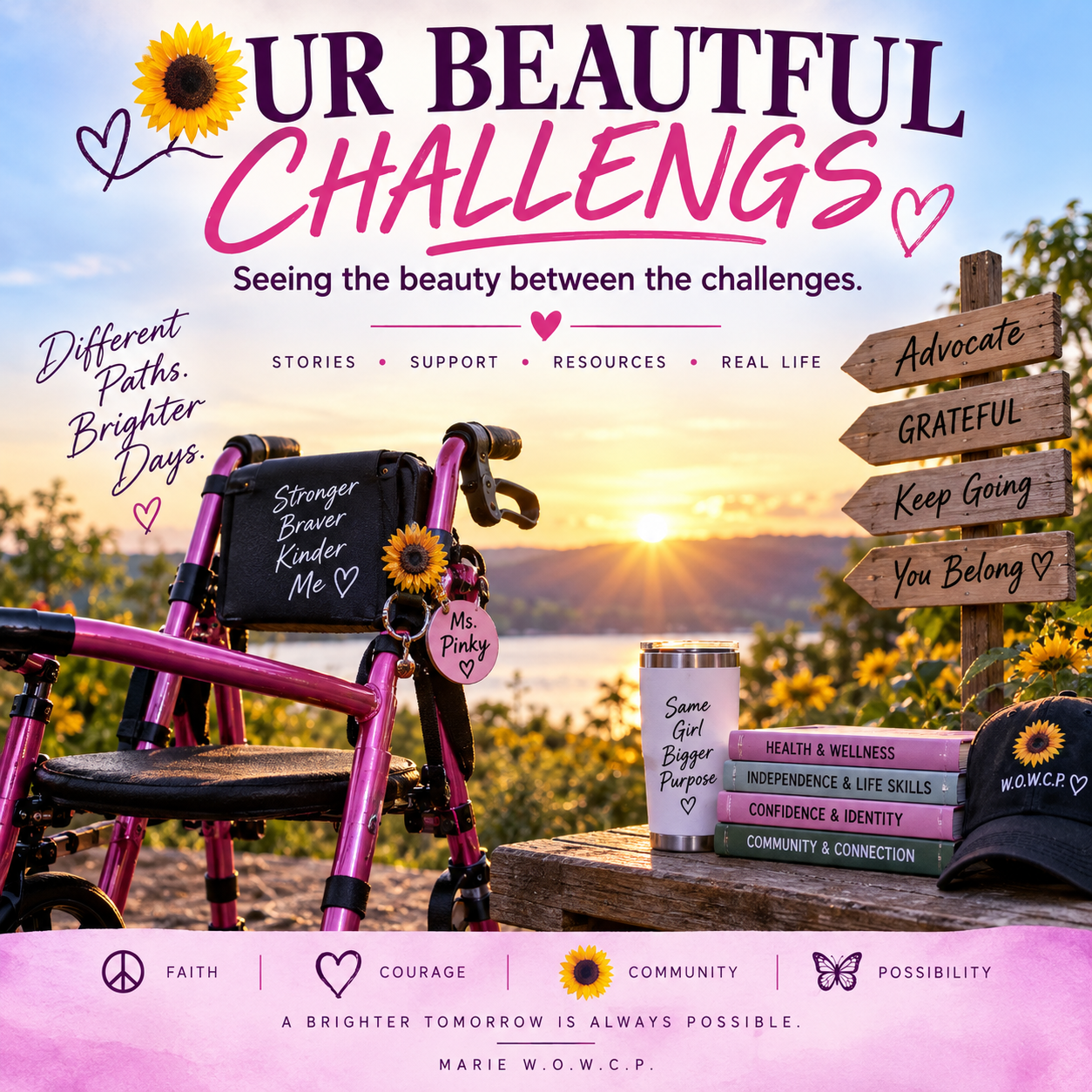
This is where Our Beautiful Challenges comes in—not just as a name, but as a way of living. Challenges don’t need to be erased to have value. They don’t need to be “fixed” to be worthy. They can be adapted to. They can be carried. And sometimes, they become the very thing that teaches us how to build a life that truly fits.

As this year comes to an end, I’m choosing gratitude over resolutions, intention over pressure, and honesty over perfection. I’m stepping into the new year not trying to become someone new, but honoring who I already am—and trusting that growth will follow.

That is the heart of Our Beautiful Challenges.
And as I close this year, that is more than enough.

Disability

WHEN LOVE CHALLED MY ABLEISM

 When Love Challenged My Ableism

For a long time, I told myself I could never date someone else with a disability.

I didn’t say it out loud—not in a way that sounded cruel—but the belief was there. Quiet. Heavy. Sitting just beneath the surface. I told myself it would be too hard, too complicated, too close to the parts of myself I was still struggling to accept.

The truth is, I wasn’t afraid of their disability.
I was afraid of my own.

This was my internalized ableism—beliefs I had absorbed over years of being underestimated, overlooked, and made to feel like “less.” Somewhere along the way, I started believing that loving someone with a disability meant doubling my limitations instead of expanding my life. I thought love needed to look normal to be safe.

And then life did what it does best—it challenged me.

George was one of the first people who showed me that connection didn’t need to fit a traditional mold to be real. We met as children through early intervention programs, surrounded by families who understood disability before we did. As adults, when we found each other again, our bond didn’t turn into romance—but it didn’t disappear either. George taught me that love can exist without romance, and still be deep, steady, and lifelong.

Thomas challenged me in a different way. When I met him through an online cerebral palsy community, I was cautious—maybe even guarded. He had cerebral palsy and was deaf, and communication required patience, creativity, and vulnerability. Our relationship forced me to confront intimacy in ways I never had before. It wasn’t easy. It wasn’t simple. But it showed me that connection doesn’t come from convenience—it comes from effort and trust. Even when our romantic relationship changed, the bond remained. Thomas taught me that love doesn’t fail just because it changes shape.

And then there was Lorenzo.

Lorenzo entered my life slowly—so slowly that for years, I didn’t realize what he was teaching me. We met on public transportation, saw each other on and off for years, and kept in touch through texts and calls that never quite turned into dates. I told myself we were just friends. But what I was really doing was protecting myself.

By the time Lorenzo and I finally came together, I had already loved two people with disabilities—despite once swearing I never would. And loving him felt different. Not because he didn’t have a disability, but because I had finally stopped running from mine.

Loving Lorenzo meant building a life that works instead of chasing one that looks right. It meant facing systems that punish disabled people for committing to each other. It meant redefining independence, partnership, and even marriage. And it meant realizing that the very thing I once feared—loving someone who understood disability from the inside—was the thing that finally allowed me to feel fully seen.

Looking back, I see how wrong my earlier belief was.

Loving people with disabilities didn’t limit my life.
It expanded it.

George taught me about steady love.
Thomas taught me about vulnerable love.
Lorenzo taught me about shared love.

And all three taught me how to love myself.

Internalized ableism told me I needed distance from disability to be happy.
Love taught me I needed honesty.

Gratitude

I am grateful for the relationships that challenged my fear.
I am grateful for the people who reflected parts of myself I once tried to hide.
And I am grateful that I learned this truth, even if it took time:

The problem was never disability.
The problem was believing I had to escape it to be worthy of love.

Disability

LOVE IN DIFFERENT SHAPE


For a long time, I believed something very strongly:
I didn’t want to fall in love with someone who had a disability.

Not because I didn’t respect people with disabilities—but because I was still struggling to accept my own. Loving someone else with challenges felt overwhelming when I was still learning how to live inside my body, my needs, and my limits. I thought loving someone without a disability would somehow make life easier.

What I didn’t understand then was that I wasn’t afraid of their disability.
I was afraid of facing mine.

Life has a way of gently—and sometimes stubbornly—teaching us what we need to learn.

Some of my earliest lessons about connection began during the Birth to Three program. While the children learned and played, parents gathered in another room, sharing fears, victories, and survival strategies. Disability didn’t feel isolating there. It felt shared.

That’s where I met George.

George had Prader-Willi syndrome, a rare genetic condition that affects growth, hunger, learning, and emotional regulation. As kids, none of that mattered. Our families leaned on each other, and for a while, our lives were deeply intertwined—until time and adulthood pulled us apart.

Years later, we found each other again in the most ordinary way—on a bus. Then again through the transportation company we both used. Conversations grew longer. Drivers teased us, telling me I should meet someone they didn’t realize I already knew.

We went on a date. We tried to be more than friends. But our disabilities were different, and romance never quite fit.

What did fit was the bond.

For more than twenty years, George has been one of the greatest loves of my life. We share a love of cars, motorcycles, family, sports, and showing up for each other—through big moments and small ones. He taught me that love doesn’t need romance to be real.

Later, after starting WOWCP—Workout With Cerebral Palsy—I met Thomas.

I had already read his story. I had shared it. And suddenly, there he was.

Thomas had cerebral palsy and was deaf due to complications from CP. Trust came slowly. Communication took creativity. Our phone conversations required a third person to relay between us. It was strange at first—getting to know a man through someone else’s voice—but connection found a way.

We fell in love.

Our relationship lasted several years, until COVID changed everything. Distance, life changes, and growth shifted us into something new. Ending the romantic relationship was painful, but what remained was deeper—a friendship rooted in honesty and respect. Thomas is one of my closest friends, and he always will be.

Then there was Lorenzo.

By the time he entered my life, I wasn’t running from disability anymore—mine or anyone else’s. I knew who I was. I knew what I needed.

Lorenzo didn’t arrive dramatically. He arrived naturally.

We’ve been together for four years now. We would love to live together. We would love to get married. But the systems meant to support us would take too much away if we did. So we adapted.

He lives in the apartment next to mine.

It’s not the dream I once imagined—but it’s the life that fits us.

Looking back, the truth is undeniable:
The three greatest loves of my life all live with disabilities.

Through them, I learned how to love deeply, patiently, and honestly.
More importantly, I learned how to love myself.

Gratitude, I’ve learned, isn’t about getting the life you imagined.
It’s about recognizing the life that shaped you.

And for every version of love that taught me how to accept myself, I am endlessly grateful.

Disability

WHEN ACCEPTANCE BECOMES THE WIN

As the year comes to an end, I find myself looking back—not just at what I’ve done, but at what I’ve learned. One lesson stands out above the rest: the hardest part of any challenge isn’t overcoming it. It’s accepting it.

When I was younger, I didn’t understand that. I saw challenges as roadblocks—temporary interruptions I just needed to push past. I couldn’t yet see the bigger picture. I didn’t know that some challenges don’t disappear; instead, they ask us to grow around them.

This year also reminded me of something else: dreams do come true. Just not always in the way we imagine. Sometimes they arrive reshaped by reality, surprising us with precisely what we were looking for all along.

I probably began learning these lessons five years ago, when I moved out on my own. That was when I discovered an independence I had always dreamed of but never fully believed was possible for me. Living on my own opened a door to a life I hadn’t let myself imagine before. Still, even then, something felt unfinished—like I was standing in the doorway but hadn’t fully stepped inside.

Part of my dream was always simple: to spend my life with someone who felt natural. For many years, I tried to force connections before I was ready, before I truly understood myself. It wasn’t until I accepted who I was—my needs, my limitations, and my strengths—that love arrived in the way it was meant to.

Two years after moving out on my own, I fell in love with a friend who had quietly been a dream of mine for years. We’ve now been together for four years, building a life grounded in understanding, patience, and care.

As much as we would love to live together, share a mailbox, and get married, we can’t—because the systems meant to support us would take so much away if we did. That truth still hurts. But instead of letting it stop us, we found a way to make our lives work. He lives in the apartment next to mine. It may not match the picture I once held in my mind, but it is honest, loving, and ours.

This is where Our Beautiful Challenges comes in—the fictional organization at the heart of my stories, shaped by the way I’ve learned to live. In that world, challenges don’t need to be erased to have value. They can be adapted to. They can be carried. And sometimes, they become the very thing that teaches us how to live fully.

When telling this story feels too hard, I let Josephine speak for me. Through her, I explore the complicated and tender parts of life—the spaces that don’t fit neatly into expectations. Josephine reminds me that there is beauty in the in-between, in lives that don’t follow traditional paths but are rich all the same.

What this year has taught me is that I don’t have to fight my challenges anymore. I can work with them. Shape my life around them. Let them guide me instead of define me.

It has taken me almost fifty years to understand this, but I can finally say it with peace in my heart:
I have everything I want.

Disability

PART 1: THE JOY HIDDEN INSIDE THE HARD MOMENTS

This series is about those moments—about the strength I found not in perfection or ease, but in breathing through the most complex and beautiful parts of my journey. Each part of this series explores how challenges shaped me, taught me, and helped me discover joy in unexpected places.


My life journey has been beautiful, but challenging. So when my yoga teacher asked us to pick a joyful moment from our journey, I surprised myself by choosing the most difficult time of my life. I decided it because those challenging moments are the ones I made it through. I reached the other side. And how many people can genuinely say they’ve fought through the most complex parts of themselves without giving up?

Most people see joyful moments as something bright and easy from the start. And yes, that would be simple. But my joyful moments come with a price, shaped by the challenges I’ve had to face. Without those struggles, I wouldn’t walk the way I do, talk the way I do, or live the independent life I’ve built as a person with a disability. If everything had come easily, I wouldn’t be who I am today.

What I’ve learned is that not every joyful moment begins joyfully. Sometimes you have to find the joy hidden inside the complex parts.

In yoga, this lesson becomes even clearer to me. When class begins, and I take that very first deep breath in, it’s like my whole body remembers what it feels like to slow down, to open, and to let myself be fully present. When the teacher says, “Breathe into the challenging moments,” it’s more than instructions for a pose—it’s a reminder of how I live my life. And when she says, “Let your breath guide you,” I can’t help but smile from within. Because, as difficult as my challenges have been, they’ve also become some of my most joyful moments. They taught me how to stay present, trust my own strength, and keep breathing even when life felt heavy.

Every time I breathe through a pose, I’m reminded that I’ve breathed through much more complex things. I’ve survived moments that once felt impossible. I’ve crossed through storms that once felt endless. And each time, I came out firmer, softer, and more myself.

So when my teacher says, “Pick a joyful moment in your life journey,” I realize I could never choose just one. Joy doesn’t show up only when life is easy. Joy shows up when you fight, when you grow, when you breathe… and when you find yourself standing on the other side of something you thought would break you.

My joy has always lived inside my challenges—and that’s what makes it so powerful.

Disability

“MORE THE 48 HOURS”-ORIGINAL SONG

Verse 1

They said I wouldn’t make it, not past the second day,
Whispered quiet in the hallway, told my parents “just pray.”
But I was born a fighter, I pushed through every doubt,
Turned every limit into something I could rise above somehow.

Pre-Chorus

I learned to breathe on broken days,
I learned to walk through heavy haze,
They never thought I’d make it far—
But look at who I are.

Chorus

’Cause I’m more than forty-eight hours,
More than the fear in their eyes,
More than the girl they counted out,
Standing here living my life.
I didn’t rush the future—
I let time open its doors.
I’m more than they expected.
I’m more than forty-eight hours… and so much more.


Verse 2

Told myself love wasn’t for me, said I’d never wear a ring,
Watched the world fall into place for others with everything.
I pushed too hard for moments that were never meant to stay,
Till I learned that letting go is how life finds its way.

Pre-Chorus

I slowed down just enough to see,
Life was coming back to me,
And in the quiet, love walked in—
An unexpected friend.

Chorus

’Cause I’m more than forty-eight hours,
More than the stories they told,
More than the “no” that shaped my start,
Growing into something bold.
I didn’t chase the future—
I let it come to my door.
I’m more than they imagined.
I’m more than forty-eight hours… and so much more.


Verse 3

Now I live a life that’s mine, supported but standing strong,
A home built from my courage, I’ve been proving them wrong.
And I found someone who loves me, someone I can call my own,
Even if the system’s rules make it hard to share a home.

Pre-Chorus

I’ve always been a square peg
In a world of circles drawn—
But I bend the world around me
Till I find a place I belong.

Chorus

’Cause I’m more than forty-eight hours,
More than the doubts they believed,
More than a puzzle piece that never
Fit where it should be.
I didn’t force the future—
I learned what waiting is for.
I’m more than they expected.
I’m more than forty-eight hours… and so much more.


Bridge

Some days feel like sunrise lighting up my skin,
Some days feel like footsteps where my future begins.
Love didn’t pass me over—no, it just took the long road home,
And now I know… I was never walking it alone.


Final Chorus

’Cause I’m more than forty-eight hours,
More than the limits they drew,
More than the world ever gave me—
I became my own breakthrough.
I didn’t rush the future—
I let my heart restore.
I’m more than they imagined.
I’m more than forty-eight hours…
And now I’m so much more.

Disability

AN UNEXPECTED LIFE: BECOMMING THE WOMEN I WAS NEVER EXPECTED TO BE

There are stories we are handed at birth, and then there are stories we write ourselves.
This is mine.


The First 48 Hours

As someone with a disability, my life began with doubt.
People told my parents I would never amount to anything.
Some said I might not make it past the first forty-eight hours.

Those words were meant to be limits.
But instead, they became fuel.

I didn’t just make it past those first hours—
I made it into days, into years, and into a life no one expected.
I learned early that survival wasn’t guaranteed,
but fighting for myself would always be part of my story.


Learning to Live, Not Just Survive

There were many moments when I didn’t think I would make it.
Times when the world felt heavy and lonely.
Seasons when I convinced myself that love, marriage, and partnership weren’t meant for people like me.

I told myself I didn’t want those things—
but deep down, I did.
I wanted the kind of life I saw everyone else living so easily.

Because of that longing, I began to rush life.
I tried to force things that weren’t ready.
I pushed myself forward without taking time to breathe or grow.
I didn’t give life a chance to meet me halfway.

But everything changed when I finally slowed down.
When I stopped chasing and allowed life to unfold naturally.
In that stillness, I stumbled into something unexpected—
something softer, steadier, and more beautiful than anything I had tried to force.

I stumbled into my life.


The Life I Never Expected

Today, I live the kind of life I once believed was impossible.

I have my own home—
not alone, but independently supported by family, friends, and a few amazing PCAs who help with my day-to-day needs.
I built a life that works for who I am and what I need.

And then, the most unexpected part of all:
I found my person.

Someone I can call mine.
Someone who loves me as I am,
who understands my challenges without me needing to explain,
who doesn’t see my disability as a barrier to love.

We dream of living together.
We dream of marriage.
We dream of a shared life.

But government assistance makes those dreams harder for people like us.
Love comes easily—
the system does not.

Still, like everything else in my life, I adapt.
I adjust.
I figure things out.

Because I’ve always been a square peg in a round hole.
And when something doesn’t work for me,
I make it work.

It’s how I survived.
It’s how I grew.
It’s how I became the woman I am today.


What My Life Feels Like Now

Some days feel like sunrise—
a soft, warm light touching places I once believed were out of reach.

Some days feel like walking a new path,
one that no one else has walked,
leaving footprints that whisper,
“Yes. A life like this is possible.”

And some days feel like holding the hand of someone who chose me,
realizing love didn’t skip over my life—
it simply took its time.


Becoming More Than Expected

I wasn’t supposed to make it past 48 hours.
Yet here I am—
living, loving, growing, building a life of my own.

I made something of myself.
Not because the world made space for me,
but because I created my own space when none existed.

The life I once feared I would never have
found me in the quiet moments,
in the slow breaths,
in the unexpected turns.

I didn’t just survive.
I became, and I won


Disability

THEY HELD HER HAND WHILE LETTING HER GROW

When the doctors placed a tiny, fragile baby into the arms of two young parents, they spoke gently:
“She may be a challenge… but she will also be a fighter.”

Those words could have felt heavy.
But instead, the young couple looked at their daughter and saw something else entirely—
a beautiful challenge.
A sweet, unexpected gift they didn’t plan for,
but one they would never give up on.

From the very beginning, they held her hand while letting her grow.

As she grew, they faced moments that tested their strength. Letting her explore, fall, and rise again wasn’t easy. Every parent wants to shield their child from pain, but these parents knew that protection alone wouldn’t prepare her for the world. They had to let her step forward, even when her steps were unsteady.

And something remarkable happened:
the harder the challenge became,
the more beautifully she grew.

Watching her face her struggles was never simple. As the years passed, it even became harder. They knew they wouldn’t always be there to stand beside her, so they taught her how to stand on her own—little by little, hand in hand.

People later asked her,
“How do you overcome so much? How do you face your challenges every day?”

Her answer was simple:
“Challenges are what I know.
They held my hand… and they let me grow.”

Because challenges don’t make you weaker—
they make you extraordinary.

To any parent raising a child with a challenge, remember this:
Hold their hand.
Hold it tightly.
But let them grow.

Because one day, the courage you taught them
will become the wings they fly with.